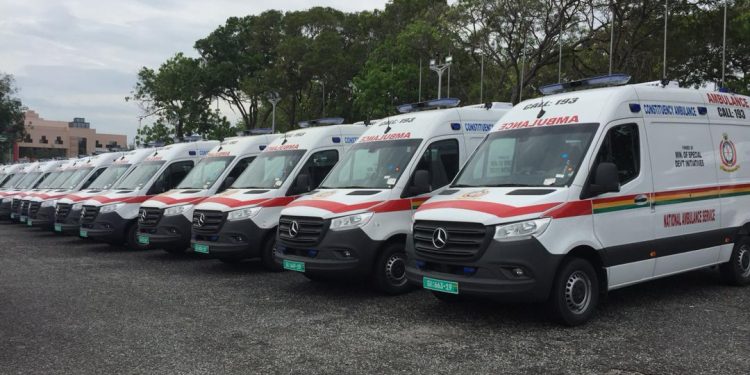
Ghana’s emergency medical system is under severe strain as the National Ambulance Service (NAS) reveals that 127 of its 318 vehicles, procured by the Nana Addo Dankwa Akufo-Addo government are currently out of commission.
This represents nearly 40 percent of the nation’s total ambulance fleet, raising urgent questions about public safety and the state of emergency response capacity.
Akufo-Addo’s ambulances
Former President Akufo-Addo on January 28, 2020, commissioned 307 ambulances at the Black Star Square in Accra, marking a major milestone in his “One Constituency, One Ambulance” initiative.
The vehicles, equipped with advanced life support systems, were distributed to all 275 constituencies in Ghana.
Maintenance Woes
However, few years after this national investment, Martin Ewuah Amoah, the Clinical Auditor for the Southern Zone of the NAS, has revealed that nearly 40% are grounded.
According to Mr. Amoah, while the service operates 318 stations nationwide, only 191 ambulances are currently functional.
He attributed the high number of grounded vehicles to the natural lifespan of emergency automobiles. “An ambulance has a lifespan of five years,” Amoah explained. “After five years, steps must be taken to replace them. Otherwise, high-maintenance issues will crop up.”
Most of the current fleet was commissioned in 2019, meaning the majority of these vehicles have now reached or exceeded their optimal operational period, leading to frequent mechanical failures.
Tragic Catalyst
The state of the ambulance service has come under intense public scrutiny following the tragic death of 29-year-old engineer Charles Amissah on February 6, 2026.
Despite being stabilized by EMTs at an accident scene, Amissah reportedly died after being turned away by three major hospitals—Ridge, Korle-Bu, and the Police Hospital—due to a lack of bed space.
The incident has reignited a national debate on the “no-bed syndrome” and the efficiency of the pre-hospital care system. Critics argue that even when ambulances are available, the lack of coordination with hospitals and the aging state of the fleet create a “death trap” for citizens in need of urgent care.
Clarification
Following the outcry, the management of the National Ambulance Service issued a statement on February 24 to clarify the situation.
They described the figure of 127 grounded vehicles as a “dynamic operational snapshot” rather than a permanent deficit.
The Service emphasized that ambulances routinely move in and out of service for scheduled maintenance and repairs. While acknowledging the challenges of an aging fleet, the NAS assured the public that dispatch operations remain active 24/7 across all regions.
However, stakeholders and medical experts continue to call for an immediate government intervention to procure a new fleet and modernize the nation’s emergency infrastructure.