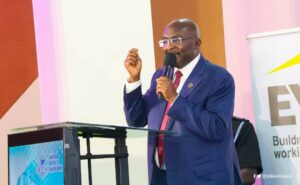
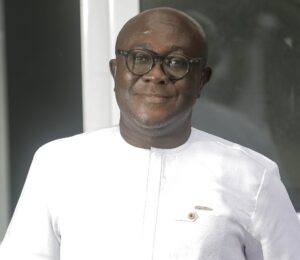
Executive Chairman of the KGL Group, Mr. Alex Apau Dadey
The Executive Chairman of the KGL Group, Mr. Alex Apau Dadey, has called for a fundamental rethinking of Ghana’s development approach, urging policymakers to view the private sector not as a competitor, but as a strategic partner in nation-building.
Delivering the 2025 University of Ghana Alumni Lecture at the Great Hall in Accra, Mr. Dadey said the time had come for the government, industry leaders, and citizens to forge stronger partnerships anchored on trust, collaboration, and shared national purpose. “Governments do not create wealth — the private sector does. The government may set the rules of the game, but it is the private sector that plays it, with innovation, capital, and resilience,” he stated. “Ghana must move beyond seeing the private sector as a rival and instead recognise it as a vital ally in national development.”
Economic History
Mr. Dadey traced Ghana’s post-independence economic evolution, noting that the collapse of once-thriving indigenous enterprises such as Siaw Industries, GNTC, and Neoplan Ghana reflected the country’s failure to protect and sustain local businesses.
He contrasted this with global success stories like Tata Motors in India and Shoprite in South Africa, which he said thrived because of deliberate state support and policy alignment that fostered home-grown enterprise.
Public-Private Partnerships
The KGL Group Chairman argued that the future of Ghana’s economy depends on effective Public-Private Partnerships (PPPs) driven by Responsible Corporate Citizenship — where business success translates into social and economic progress.
“Every thriving economy reaches a point where the government can no longer do it alone. The private sector must not only be involved — it must lead. But it cannot do so in isolation,” he emphasised.
He said effective PPPs require clarity of vision, fair risk-sharing, and strong governance, adding that they hold the key to bridging Ghana’s innovation and infrastructure gaps.
Role of the Diaspora
Mr. Dadey also called for a national mindset shift toward economic ownership, stressing that Ghana’s independence must be built on the control of its resources, industries, and intellectual capital.
He underscored the strategic importance of the Ghanaian diaspora, describing it as an untapped force for national transformation. “No country has developed or sustained progress without the engagement and commitment of its most valuable human resource — its diaspora,” he said.
Mr. Dadey advocated for a new focus on Diaspora Direct Investment (DDI), in which global Ghanaians channel their capital, knowledge, and expertise into national development, complementing traditional Foreign Direct Investment (FDI).
Touching on sustainability, he highlighted the role of Environmental, Social, and Governance (ESG) principles in building responsible and future-ready businesses.
He cited the KGL Foundation as a model of corporate responsibility, with impactful interventions in youth empowerment, education, health, arts, culture, and sports. The Foundation has awarded over 300 scholarships to brilliant but needy students across the country.
Mr. Dadey concluded by calling on government, industry, academia, and the diaspora to work together to redefine Ghana’s development narrative through innovation, ownership, and responsible partnership.
“Our future lies in collaboration — not competition — between the public and private sectors. Together, we can build a Ghana that creates, sustains, and owns its prosperity,” he said.