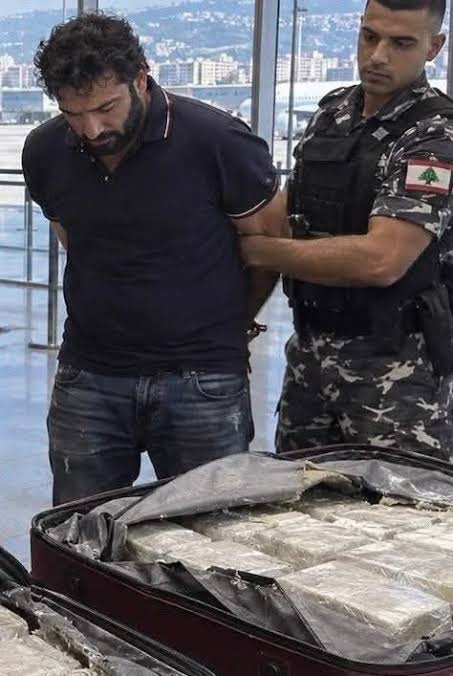
Lebanese authorities have seized 46.7 kilogrammes of cocaine from a Syrian national who arrived at Beirut’s Rafic Hariri International Airport on a flight from Accra, Ghana, in what has been described as the largest narcotics seizure in the airport’s history.
The suspect was arrested on Saturday, October 31, 2026, after arriving in Beirut with the drugs allegedly concealed in two pieces of luggage.
Ghana’s Narcotics Control Commission (NACOC) has confirmed that the arrest resulted from a coordinated operation involving Ghanaian and Lebanese drug enforcement agencies, aimed at identifying individuals connected to an international drug trafficking network.
In a statement issued on Sunday, November 1, NACOC disclosed that it was pursuing suspected accomplices in Ghana as part of efforts to dismantle the criminal network behind the shipment.
The latest seizure comes amid renewed demands by the Minority in Parliament for an independent parliamentary investigation into major international cocaine interceptions reportedly linked to Ghana.
The Minority has challenged Speaker Alban Bagbin’s decision to block an earlier proposed inquiry, arguing that Parliament must examine possible weaknesses in the country’s border security, customs controls and intelligence coordination.
Suspect Arrived from Accra
Lebanese reports identified the suspect as a Syrian national with the initials B.H., who reportedly arrived aboard Middle East Airlines flight MEA 576 from Accra.
According to the reports, the suspect had entered Lebanon through the Masnaa border crossing several weeks earlier before travelling to Ghana and subsequently returning to Beirut.
Investigators reportedly suspect that he was acting as a courier for an organised drug trafficking network.
Lebanese news outlet Daily Beirut reported that security officials monitored the suspect after his arrival at the airport before coordinating with customs officers to inspect his luggage.
The search reportedly uncovered 40 packages of cocaine, together with electronic tracking devices identified as Apple AirTags.
While Lebanese reports put the quantity seized at 46.7 kilogrammes, NACOC’s official statement described the shipment as approximately 40 kilogrammes of suspected cocaine.
The discrepancy in the reported quantities has not been officially clarified.
NACOC Confirms Joint Intelligence Operation
NACOC said the arrest was the outcome of a coordinated controlled delivery operation undertaken through cooperation between Ghanaian and Lebanese law enforcement authorities.
“This successful apprehension resulted from a coordinated controlled delivery exercise, carried out through close operational cooperation between Ghanaian and Lebanese drug law enforcement authorities,” the Commission stated.
It explained that the operation was intended to identify suspects at different points in the trafficking network and gather intelligence on the wider criminal organisation.
“The joint operation aimed to identify and apprehend targets at both ends of the supply chain while gathering vital intelligence to dismantle the broader transnational criminal syndicate behind the shipment,” NACOC added.
The Commission further confirmed that efforts were underway to apprehend suspected accomplices in Ghana.
“As part of ongoing operation, NACOC is working to arrest his accomplices in Ghana,” the statement said.
However, NACOC did not disclose the identities of the suspects being pursued, the number of individuals involved or whether any arrests had already been made in Ghana.
It also did not establish the origin of the narcotics or where they were concealed in the passenger’s luggage.
Although the suspect departed from Accra, the available information does not conclusively establish that the cocaine originated in Ghana or was placed in the luggage at Kotoka International Airport.
Minority Demands Probe into Cocaine Seizures
The latest development comes as the Minority in Parliament intensifies its demand for a parliamentary investigation into international cocaine seizures reportedly involving consignments linked to Ghana.
The Minority has filed a formal motion challenging Speaker Alban Bagbin’s September 29, 2026 ruling, which declared a proposed parliamentary inquiry inadmissible.
The motion, filed by First Deputy Minority Whip and Tolon MP Habib Iddrisu, invokes Standing Order 127 of Parliament’s Standing Orders and seeks a review of the Speaker’s decision.
Mr Bagbin had ruled that proceeding with the proposed inquiry could prejudice ongoing criminal proceedings involving approximately 21 individuals in four separate narcotics-related cases.
However, Minority Leader Alexander Afenyo-Markin maintains that ongoing criminal prosecutions should not prevent Parliament from examining possible institutional failures in the fight against international drug trafficking.
According to him, the proposed investigation is intended to assess the effectiveness of public institutions responsible for border security, customs enforcement and intelligence coordination, rather than determine the guilt or innocence of individuals facing prosecution.
Earlier International Seizures Raise Concerns
The Minority Leader has cited several international cocaine interceptions allegedly linked to Ghana as justification for the proposed parliamentary investigation.
Among them is the reported seizure of approximately 3.9 tonnes of cocaine at the Port of Dunkirk in France on September 7, 2026.
The consignment, reportedly concealed in a shipment of plastic waste originating from Ghana, was estimated to be worth €225 million.
Mr Afenyo-Markin also referred to reported seizures in Amsterdam, Antwerp and Sydney, as well as suspected interceptions in Ghana, including incidents around the Tema Harbour enclave and Pedu Junction.
The Minority argues that the incidents raise questions about cargo inspection procedures, border protection, customs supervision and the coordination of intelligence among security agencies.
It wants Parliament to establish whether institutional or regulatory weaknesses have created opportunities for international narcotics trafficking networks.
Mr Afenyo-Markin has maintained that criminal prosecutions and parliamentary oversight serve different purposes and can proceed without necessarily undermining each other.
While the courts determine individual criminal liability, he argues, Parliament has a responsibility to examine the performance of public institutions and recommend corrective measures where necessary.
Investigations Continue
Meanwhile, Ghanaian and Lebanese authorities are continuing investigations into the Beirut seizure to identify other individuals suspected of involvement in the shipment.
NACOC has described the operation as an example of the importance of international intelligence-sharing and cooperation in combating transnational drug trafficking.
The Commission said the joint exercise demonstrated the commitment of both countries to disrupting international narcotics networks through coordinated enforcement.
Its statement was signed by PNCO Francis Opoku Amoah, Acting Director of Public Affairs and International Relations.
The latest seizure adds to the public debate over Ghana’s exposure to international narcotics trafficking, although the circumstances surrounding the Beirut shipment remain under investigation.
The outcome of the ongoing investigations and the Minority’s parliamentary motion could provide further insight into the effectiveness of existing drug enforcement and oversight arrangements.