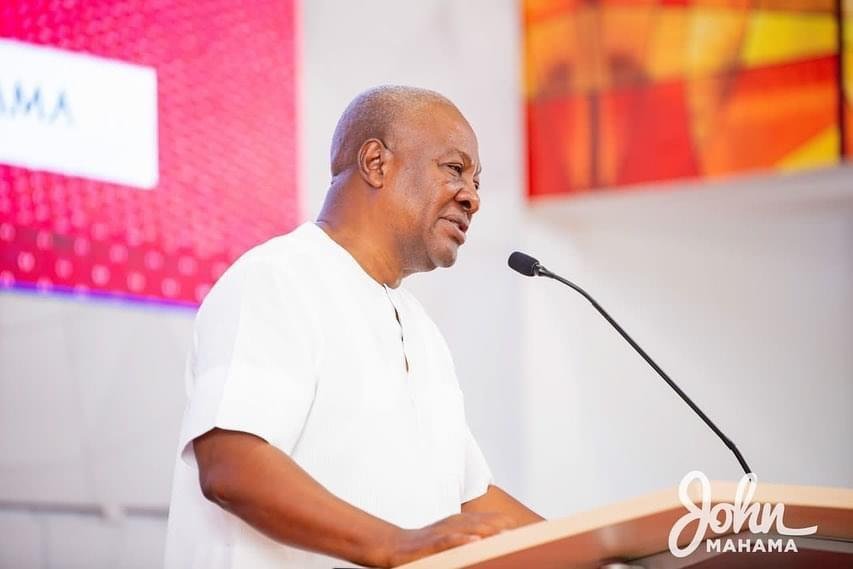
President John Mahama
The controversy over whether President John Dramani Mahama can seek another presidential term has triggered multiple legal actions before the Supreme Court, with opposing parties seeking judicial interpretation of the constitutional provisions governing presidential term limits.
The legal dispute centres on Article 66(2) of the 1992 Constitution, which provides that a person shall not be elected to hold office as President of Ghana for more than two terms.
While separate actions reportedly initiated by a group sympathetic to the National Democratic Congress (NDC) and an individual identified as Ken Kurankye seek a declaration permitting President Mahama to contest another term, the New Patriotic Party (NPP) has instituted its own action seeking an interpretation that would prevent a third presidential term.
The NPP’s National Second Vice-Chairman, Henry Nana Boakye, popularly known as Nana B, has defended the party’s decision to pursue a separate suit rather than join the existing proceedings.
According to him, the move is intended to ensure that the Supreme Court hears comprehensive legal arguments against any interpretation of the Constitution that could permit a person who has already served two presidential terms to seek another.
NPP Explains Separate Court Action
Mr Boakye said the party was aware of pending Supreme Court actions seeking a declaration that President Mahama could contest a third term.
He argued that relying solely on those proceedings would have been politically risky, particularly given the possibility that arguments opposing the proposed interpretation might not be adequately presented.
Drawing comparisons with previous litigation involving the Office of the Special Prosecutor (OSP), he recalled that the Attorney-General had supported the plaintiff’s position in that case, while civil society organisations intervened to defend the institution.
He maintained that the experience informed the NPP’s decision to initiate independent proceedings rather than depend on the Attorney-General or other parties to advance its constitutional position.
Mr Boakye explained that the party also considered applying to join the existing action but decided against that option because an application for joinder would be subject to the Supreme Court’s discretion.
Consequently, the NPP opted to commence its own case to place what he described as stronger constitutional arguments before the court.
He said the decision was consistent with the party’s history of defending the 1992 Constitution and ensuring that constitutional safeguards were not undermined by political interests.
NPP Seeks Interpretation of Presidential Term Limits
In its writ invoking the Supreme Court’s original jurisdiction, the NPP names the Attorney-General as defendant and seeks several declarations concerning the interpretation of Articles 58(2), 60(6), 66(1), 66(2) and 66(3) of the Constitution.
The party is asking the court to declare that the constitutional limitation of two presidential terms applies irrespective of whether those terms were served consecutively or at different periods.
It further seeks a declaration that a person elected President cannot hold office for more than two terms, with each term consisting of four years, whether the person wins consecutive elections or returns to office after an intervening administration.
The action also raises questions about the eligibility of a Vice-President who assumes the presidency following a vacancy and subsequently seeks election to the office.
The NPP wants the Supreme Court to clarify how such succession arrangements affect the constitutional limitation on presidential terms.
Constitutional Interpretation at Centre of Dispute
In its statement of case, the NPP argues that Article 66(2) imposes an absolute limit of two terms on any person elected President, rather than merely prohibiting three consecutive terms.
The party maintains that an interpretation allowing a former President to contest another two terms after losing an election would undermine the purpose of the constitutional restriction.
According to its legal arguments, the Constitution limits the total number of terms a person may serve as President and does not create a fresh entitlement whenever a former President returns to office after a break.
The party further argues that presidential term limits are intended to prevent excessive concentration of executive power and safeguard Ghana’s democratic system.
Its lawyers invite the Supreme Court to adopt a purposive interpretation of the Constitution, taking into account the objectives of presidential term limits and the broader principles underpinning constitutional democracy.
The statement of case also draws on experiences from other African countries where attempts to extend presidential tenure have generated political tensions, constitutional disputes and public protests.
The NPP contends that a clear judicial interpretation would help prevent uncertainty over presidential eligibility and protect the stability of Ghana’s constitutional order.
Legal Action Filed by Dame and Partners
The NPP’s writ and accompanying statement of case were prepared by Dame and Partners, with former Attorney-General Godfred Yeboah Dame named as solicitor for the party.
The court documents identify the NPP as plaintiff and the Attorney-General as defendant.
An affidavit verifying the statement of case was sworn by the party’s General Secretary, Justin Kodua Frimpong.
The legal action invokes the Supreme Court’s original jurisdiction under Articles 2(1) and 130(1) of the Constitution, which concern constitutional enforcement and interpretation.
Supreme Court to Determine Constitutional Questions
The emerging legal dispute places the interpretation of presidential term limits at the centre of national political and constitutional debate.
The competing positions raise a fundamental question about whether the two-term restriction under Article 66 applies to a person’s cumulative service as President or whether a break between terms could affect eligibility.
For the NPP, the answer is clear: a person who has already served two presidential terms cannot qualify for another, regardless of whether the terms were consecutive.
Mr Boakye maintained that the party’s decision to initiate separate proceedings would enable it to present its own legal arguments and seek a definitive interpretation from the Supreme Court.
The final determination of the constitutional questions rests with the Supreme Court, whose ruling could clarify the application of presidential term limits to both former Presidents and Vice-Presidents who assume the presidency under the Constitution.