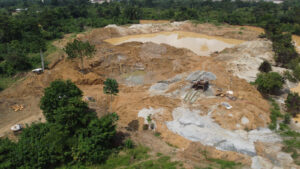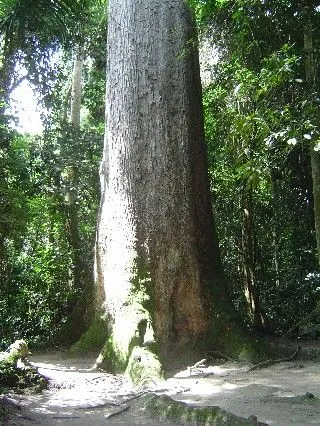
Residents of communities such as Akyem Oda, Akyem Asuom, Akyem Asuboa, Aprokumase, Tabita and several others around the Oda Big Tree have raised concerns over the deforestation of the area surrounding the location of the tree.
When the Daily Statesman visited the locality, huge machines were seen bringing down part of the Essen-Apam Forest Reserve.
Some residents who spoke to us stated that a compartment of the forest reserve had been leased to a company that was clearing the forest for a rubber plantation. They worried that the company might extend the felling of trees to the area where the Big Tree is located and bring down the landmark.
Parochial Interest
A man introduced to us as an attendant at the Oda Big Tree, who spoke on condition of anonymity, said the people were saddened that the virgin forest was being brought down ‘because of somebody’s parochial interest’.
Some residents who spoke to the Daily Statesman called on the government to add its voice to efforts to ensure that the company working in the Essen-Apam Forest Reserve did not extend its activities to the area where the Big Tree is located.
Kofi Agyepong, a resident of Akyem Oda, said, “Whoever is behind the act is a threat to tourism and an enemy of Ghana.” Other residents threatened to use all the force at their disposal to prevent the company from extending its activities to the area where the Big Tree is located.
However, the Municipal Manager of the Forestry Commission in the Birim Central Municipality, Mr Ernest Nkansah-Kwarteng, told us that the forest that is home to the Big Tree is known as the Asubone Forest Reserve and is different from the Essen-Apam Forest Reserve, where the work is currently ongoing.
He said people found it difficult to distinguish between the two forest reserves because of their proximity. He said that part of the country had about three different forest compartments in the records of the Forestry Commission, but many residents did not know this.
Mr Nkansah-Kwarteng said extensive research had led the Forestry Commission to conclude that the part of the Essen-Apam Forest Reserve where a company known as Platinum Plantations Ltd was working had been degraded beyond repair. As such, the company had decided to undertake a plantation project to save the land. He added that the company had been working in the area for about two years and had so far employed about 200 local youths.
He said he believed the people were agitating because the company’s work had reached the roadside and moved closer to the Asubone Forest Reserve, where the Big Tree is located.
“They have been working there for over two years. Go to the very remote communities in the area and you will see a huge rubber plantation there. They are only expanding their work to reach other parts of the compartment they have legally acquired,” he told the Daily Statesman.
Rubber and Teak
Mr Nkansah-Kwarteng said the company had gone through all the appropriate legal processes to acquire the compartment from the Forestry Commission. He added that the Commission had to embark on a plantation project to reclaim that part of the forest, which had become degraded due to human activities.
The Forestry Commission of the Ministry of Lands and Natural Resources noted in its 2015 “Annual Report on Forest Plantation Development Programme”:
“In September 2015, the FC signed a [Public-Private Partnership] agreement with the company for the development of 1,210.36ha of commercial rubber and teak plantations in the Essen Epam Forest Reserve, Akim Oda Forest District, Eastern Region.”
Obrempong Sintim Poku, Chief of Akyem Manso and Benkumhene of the Akyem Kotoku Traditional Area, who was one of the signatories to the contract between the Forestry Commission and Platinum Plantations Ltd, said he was certain before signing that the concession did not extend to the area where the Big Tree stands.
“Though, even as a landowner, I do not wield much power since that part of the forest has been taken over by the Forestry Commission, I still would not have signed if the compartment extended to where the Big Tree is,” he told the Daily Statesman.
The chief said he was convinced, based on the documentation and research conducted by experts, that the portion of the forest needed to undergo a plantation process to regain its forested status because of the level of degradation. That was why he agreed to it.
Obrempong Sintim Poku told the Daily Statesman that he was in talks with the Ghana Tourism Authority to take over the Big Tree from the Commission and develop it into a proper tourist site.
Oda Big Tree
The Oda Big Tree is believed to be the biggest tree in West Africa.
It has a diameter of 3.22 metres at a height of 1.37 metres and 2.72 metres at a height of 3.1 metres, making it 12 metres in circumference and between 66.5 and 90 metres tall. Its girth is 10.11 metres at a height of 1.4 metres and 8.63 metres at a height of 3.1 metres.
It is located at Aprokumase in the Birim Central Municipality.
Although many believe the tree is located in the Essen-Apam Forest Reserve, documents held by the Forestry Commission state that the tree stands in the Asuboni Reserve.
Tourism
When the Daily Statesman contacted Kwadwo Antwi, Chief Executive Officer of the Ghana Tourism Development Company (GTDC), to discuss what the company was doing about the Big Tree, he told us that plans were in place to take over the site from the Forestry Commission.
Mr Antwi said the only attraction in the area managed by the GTDC was a ‘dilapidated’ recreational facility opposite the forest in which the Big Tree stands. He added that the GTDC was considering establishing a highway rest stop with recreational facilities, accommodation, a fuel station and properly managed lavatories for tourists and other visitors.
He said that although the GTDC had stationed a worker at the Big Tree to help keep the place in good condition for tourists and other visitors, the company did not have total control over the site. The GTDC would, however, continue to negotiate with the Forestry Commission to take full control of the Big Tree in order to develop the area into a proper tourist site.
This story was first published in the Daily Statesman Newspaper and in sayitright2016.wordpress.com on 29th June 2018 by Nana Kwasi Asuman-Frimpong