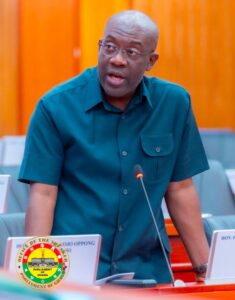
Nana Kwasi Asuman-Frimpong, Esq
Legal practitioner and consumer rights advocate Nana Kwasi Asuman-Frimpong, Esq., has called for stronger protection for Micro, Small and Medium-sized Enterprises (MSMEs) as advocacy for a comprehensive consumer protection law in Ghana intensifies.
According to Mr Asuman-Frimpong, also the Founder and Advisory Council Chairman of ICEDEG Africa LBG, a policy think tank focused on fair competition, consumer protection, and policy development, Ghana has a unique opportunity to redefine the term consumer to include qualifying MSMEs before Parliament passes the Consumer Protection Bill.
Speaking at the Fair Competition and Consumer Rights Advocacy Series on Friday, November 6, 2026, Mr Asuman-Frimpong noted that the definition of a consumer under Ghana’s Consumer Protection Bill, 2023, is primarily oriented towards personal, family and household consumption, thereby excluding many ordinary business transactions involving MSMEs.
Section 92 of the Bill defines a consumer as a person who buys goods or services for personal, family or household use without the intention of resale, or an individual who uses a product for personal rather than commercial purposes.
According to Mr Asuman-Frimpong, this definition reflects an important weakness in conventional consumer protection legislation, which assumes that every business purchaser possesses sufficient commercial knowledge and bargaining power to protect their interests.
He noted that this assumption is not always accurate, explaining that a microenterprise purchasing banking services, business equipment or digital services may face substantial information disadvantages when dealing with a large corporation.
He therefore recommended extending specified statutory protections to qualifying micro and small enterprises, taking into consideration their size, transaction value, standard-form contractual terms and relative bargaining power.
Describing MSMEs as part of the “gig economy”, or what he referred to in Kumasi parlance as the “kpa kpa economy”, Mr Asuman-Frimpong emphasised their importance to Ghana’s economy, noting that the sector provides livelihoods for many Ghanaian women and young people, making it necessary to introduce special protections against unfair commercial practices and exploitation.
Clarification
Mr Asuman-Frimpong clarified that his proposal was not intended to classify every business as a consumer or bring all commercial transactions under consumer protection legislation. Rather, he advocated extending specified statutory protections to qualifying micro and small enterprises that face substantial disadvantages when dealing with larger businesses. He explained that such protection should be determined by factors including enterprise size, the nature of the transaction, information asymmetry and relative bargaining power.
According to him, this would help protect smaller enterprises against unfair contractual terms, misleading representations and hidden charges without unnecessarily restricting legitimate commercial activities or undermining fair competition.
Identified Gaps
Meanwhile, Mr Asuman-Frimpong identified five fundamental gaps in Ghana’s existing legal framework that have rendered the current laws and regulatory institutions insufficient to guarantee adequate consumer protection.
The gaps include the fragmentation of consumer rights; the distinction between regulatory sanctions and consumer remedies; unequal bargaining power and information asymmetry; inadequate coverage of emerging markets; and the limited statutory role of consumer associations.
He explained that although Ghana has several sector-specific laws and regulatory institutions with consumer protection responsibilities, the absence of a comprehensive legal framework continues to undermine effective enforcement and access to remedies.
He noted that while the Consumer Protection Bill, 2023, recognises some of these challenges and proposes measures to address them, the delay in its passage has prolonged the difficulties consumers face in securing adequate protection.
The Event
The programme, organised under the theme “Advocating for a Comprehensive Consumer Protection Law in Ghana”, brought together experts from academia, legal practice, consumer rights advocacy and civil society to discuss the need for comprehensive consumer protection legislation in Ghana.
Participants included regulators, lawyers, business owners, students, civil society representatives and regional competition authority officials, among others.
Other speakers included Dr Francisca Kusi Appiah, Managing Consultant of K-APP Law; Elvira Dery, Esq., Deputy Chairperson for Strategic Events and Diplomacy (OVP); Appiah Kusi Adomako, West Africa Regional Director of CUTS International; and Joseph Nyindam Nanga, Executive Director of Action Youth for Development-Ghana.