The Minerals Commission has defended its decision to terminate the mineral rights of Northern Ashanti Mines Limited, formerly Owere Mines, insisting the company persistently defaulted on its statutory obligations and the termination followed due process.
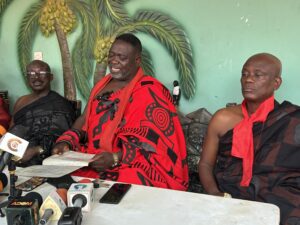
At a press briefing held at the head office of the Commission in Accra today [Thursday, 29th October 2026] to address the revocation and the company’s subsequent response, the Commission said it was placing the full sequence of events before Ghanaians.
“A mineral right is not a gift, and it is not an inheritance! It is a privilege conferred by the State on terms, and those terms must be honoured! No company, whether indigenous or foreign may hold the resources of the Republic, withhold what is owed to the people of Ghana, and then turn around to cry foul when the law takes its course,” the Commission stated.
The Commission unequivocally rejected allegations by Northern Ashanti Mines that it acted in bad faith and denigrated the Minister for Lands and Natural Resources for exercising his legal authority.
“We want to unequivocally state that we reject these allegations in their entirety. The Minister acted within his lawful jurisdiction, as required by law. The Commission acted within its statutory mandate. The record is one of persistent default by the Company and persistent forbearance by the State,” it said.
*Sequence of US$8.3m Debt*
Giving the chronology, the Commission said:
– In January 2010, Owere Mines acquired a mining lease covering 595 cadastral blocks.
– Under section 24 of the Minerals and Mining Act, 2006 (Act 703), the company was bound to pay Annual Mineral Right (AMR) fees annually. It did not.
– On 28th May 2020, the Commission issued a Notice to Remedy Breach. The company was already in default in excess of US$4 million.
– Following the takeover by BCM Investments, the company proposed vague payment terms in 4 tranches. In June 2020, the Commission accepted in principle but requested specific dates. The company failed to adhere to even that.
– On 5th November 2020, the Commission wrote again. The company requested a meeting.
– On 13th October 2022, with payments still not received, debt had ballooned to US$5,595,238.14.
– By 29th December 2022, debt stood at US$6,188,000.
– On 14th April 2025, another notice was served including prospecting licences fees from 2019 to 2025. Total owed was US$8,330,000 for mining leases and US$49,928 for prospecting licences.
The Commission said on 7th April 2026, a full year after the last notice, it notified the Hon. Minister for Lands and Natural Resources to issue a notice of termination. The Minister approved, and the Commission proceeded to terminate.
*US$300k, Not US$1m Paid*
Responding to the company’s claim that the US$8 million figure is wrong, the Commission asked the public to do the arithmetic.
“As at 29th December 2022, the debt stood at approximately US$6,000,000. The Company remained in default thereafter, and the debt continued to accrue through 2025, bringing the total to US$8,330,000… so where is the discrepancy in our reporting?”
It added that records show the company paid only US$300,000 in two tranches, not the US$1,000,000 it claims.
“For a company that claims to have spent US$200,000,000 on the mine, what prevented it from paying the US$8,000,000 owed to the people of Ghana?” the Commission quizzed.
*Go To Court, Not Media*
The Commission said the company cannot claim to seek dialogue while suing the Minister, the Commission and the Attorney-General and litigating in the media.
“A company that sues… is not a company seeking dialogue. It is a company seeking to litigate in court and in the media simultaneously. That is improper, and it is contemptuous of the judicial process.”
It said upon termination, the mineral rights have reverted to the State as lawful owner, without prejudice to all liabilities prior to termination, including the indebtedness. The Commission reserves the right to pursue all sums owed and to protect and secure the reverted assets from being dissipated or overrun by encroachers, as provided under section 70 of Act 703.
“The Minerals Commission acted lawfully and followed due process at every stage. The Company was given several opportunities to regularise its position and chose not to. No one is above the law in this country. If you flout the laws, there are sanctions, and those sanctions will apply,” the Commission concluded.