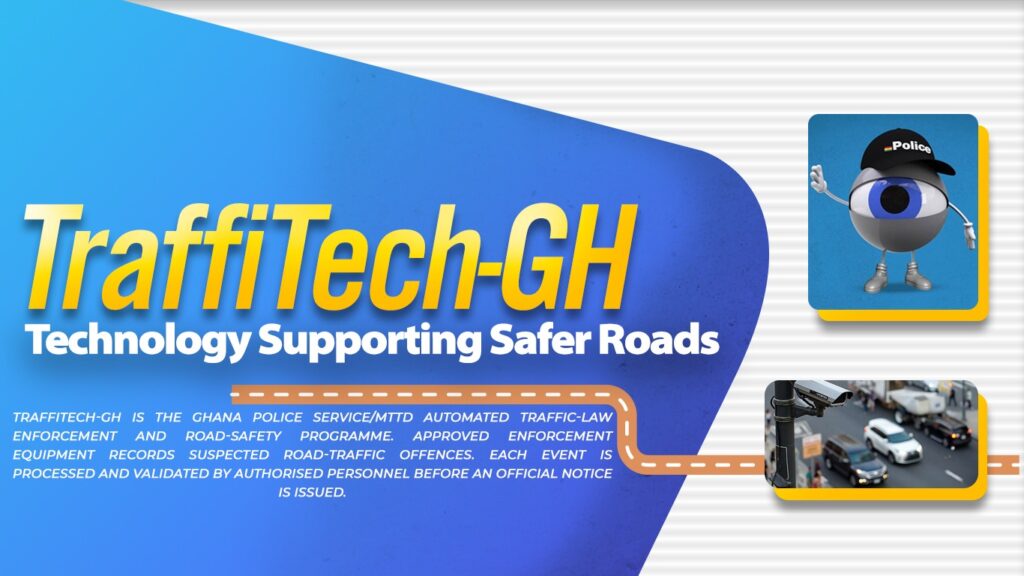
No responsible Ghanaian citizen should oppose efforts to reduce road deaths. If excessive speeding contributes to traffic fatalities, then effective enforcement is necessary. Technology can improve compliance, reduce discretion, and strengthen public safety.
Yet in a constitutional democracy, enforcement legitimacy depends not only on catching offenders. It depends equally on protecting the rights of those accused.
That is why the contest procedure under Ghana’s new TraffiTech-GH regime deserves closer public scrutiny.
Under the current process, a motorist who receives an Electronic Notice of Violation (ENV) must challenge the allegation through an administrative procedure, engage with the police, and only thereafter proceed towards a court hearing. As a result, access to an independent tribunal is effectively mediated by the authority that issued the allegation.
This raises a simple but profound constitutional question: Why should a citizen be required to pass through the accuser before reaching the adjudicator?
The 1992 Constitution was designed not merely to empower state institutions but also to protect citizens against arbitrary exercises of power. Article 19 guarantees the right to a fair hearing. Article 23 requires administrative bodies and officials to act fairly and reasonably and entitles aggrieved persons to seek redress against administrative action.
These provisions embody a fundamental principle of natural justice: separating accusation from determination.
The authority that alleges wrongdoing should not be perceived as controlling access to the authority that determines whether the allegation is true.
Supporters of the current procedure will no doubt argue that it promotes administrative efficiency. It may reduce the burden on the courts. It may allow some disputes to be resolved without litigation. It may prevent frivolous challenges.
Those considerations may be legitimate.
But efficiency cannot be allowed to eclipse fairness.
The purpose of the courts is not administrative convenience. The purpose of the courts is independent adjudication.
Where a motorist accepts liability, payment should end the matter. But where a motorist disputes liability, the State should bear a heavy burden to justify any procedural obstacle placed between that citizen and an impartial hearing.
The issue here is not whether the Ghana Police Service acts in good faith. The issue is whether the structure of the process inspires public confidence in its impartiality.
Justice must not only be done; it must manifestly be seen to be done.
Many motorists will inevitably ask why they must first engage with the enforcement authority before their case reaches an independent court. Others may question whether an administrative process that begins and ends within the enforcement system adequately safeguards constitutional rights.
These questions should not be dismissed as attempts to avoid accountability. They are legitimate concerns arising from the relationship between citizens and state power.
Even more troubling are reports that motorists are being discouraged from contesting alleged violations because doing so could trigger additional investigations into their vehicles. Whether such warnings reflect official policy is almost irrelevant. Their effect is to create the perception that exercising a legal right may invite unwanted consequences.
No citizen should feel intimidated for exercising a lawful right of challenge.
The right to contest an allegation is not a privilege granted by the State. It is a safeguard against the possibility of State error.
Technology, after all, is neither infallible nor beyond scrutiny. Cameras can malfunction. Databases can contain inaccuracies. Vehicle ownership records can be outdated. Evidence can be misinterpreted. Human error remains possible.
That is precisely why constitutional democracies provide for independent review.
The question before all of us therefore extends far beyond traffic enforcement. It concerns the proper balance between public safety and civil liberty.
If the State can issue allegations electronically, demand payment within fourteen days, impose financial consequences for default, and require citizens to navigate an enforcement-led process before obtaining access to a court, then the public is entitled to a clear explanation of the legal and constitutional basis for those requirements.
If the law expressly requires motorists to pass through a police-managed process before obtaining a hearing, then policymakers must justify why that requirement is consistent with Articles 19 and 23 of the Constitution. If no such requirement exists in law, the procedure should be revised immediately.
Equally important, motorists who reject an allegation should have a straightforward path to an independent hearing without fear, intimidation, or the perception that exercising a constitutional right will trigger additional scrutiny. A citizen who seeks justice should not be made to feel that justice comes at a cost.
Road safety is a national imperative. But constitutional rights are not administrative inconveniences to be managed away in the pursuit of efficiency. They are the foundation of democratic government.
The time has come for a public review of the TraffiTech-GH contest procedure. Parliament should demand clarity. Civil society organisations should examine its constitutional implications. The legal profession should subject it to rigorous scrutiny. And citizens should insist that technological innovation in law enforcement remains firmly anchored to the principles of due process and natural justice.
Ghanaians should not have to choose between safer roads and constitutional freedom. We are entitled to both.
Until that assurance is unequivocally provided, the question that hangs over TraffiTech-GH is not whether it catches speeding motorists. The question is whether, in the process, it risks slowing the citizen’s path to justice.