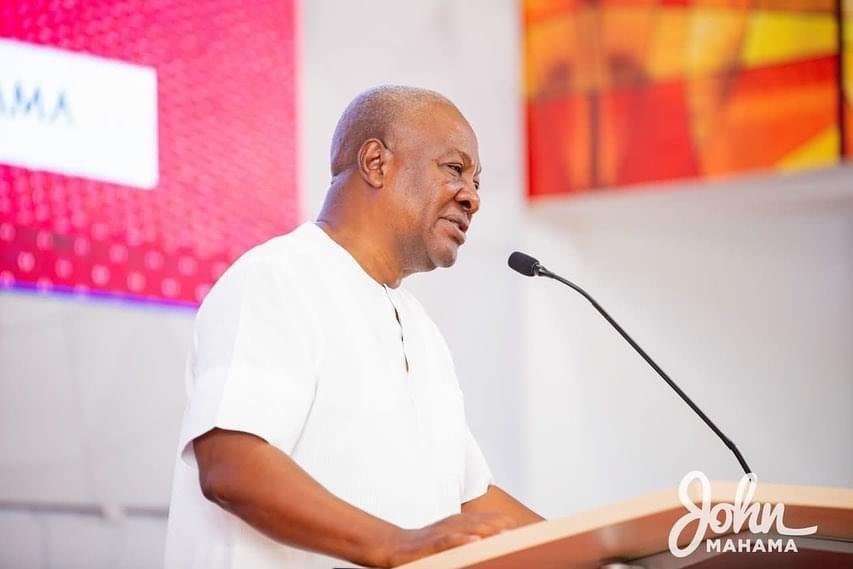
President John Mahama
President John Dramani Mahama has come under mounting scrutiny after failing to respond to a Right to Information (RTI) request seeking clarity on the payment of Article 71 emoluments for the period 2021–2025, covering the second term of the erstwhile Akufo-Addo administration.
The application, filed on 7 October 2025 by Kofi Asare, requested details on the implementation of emolument determinations approved by Parliament and the President for former Article 71 office holders — including the former president, former vice president, Council of State members, and other former executive appointees.
Under Section 23(1) of the Right to Information Act, 2019 (Act 989), public institutions are required to respond to such applications within 14 days. However, more than 22 days after submission, the Office of the President is yet to provide any response or official communication.
Breaches
Following the expiration of the statutory period, Mr Asare filed an internal review application on 24 October 2025, citing non-compliance by the Presidency. As of 30 October 2025, both the main RTI request and the review application remained unanswered.
Legal analysts say the delay constitutes a breach of Act 989, which mandates prompt responses to public information requests, particularly those relating to expenditure of public funds.
MPs and Speaker Already Paid
The controversy has intensified following revelations that Members of Parliament (MPs) and the Speaker of Parliament have already received their ex-gratia payments for the 2021–2025 period.
A response to a separate RTI request to Parliament, dated 14 October 2025 and signed by Camillo Pwamang, Deputy Clerk (LMS), confirmed that lawmakers and the Speaker had been fully paid.
Parliament’s correspondence stated that the formal determination of Article 71 emoluments — made at its 399th sitting on 6 January 2025 — was duly transmitted to the President on the same date. However, it added that Parliament had not received any confirmation from the Ministry of Finance or the Controller and Accountant-General’s Department (CAGD) regarding payments to former Article 71 office holders in the executive and the Council of State.
“Parliament has, however, received releases from the CAGD reflecting the emoluments determined by the President for the same period,” the letter stated — effectively confirming that while MPs have been paid, other former officials remain unpaid.
Accountability Questions
In his internal review application, Mr Asare argued that the Presidency’s silence breached both statutory and constitutional obligations. He cited four grounds for the review, including non-compliance with Section 23(1) of Act 989 and the violation of Article 21(1)(f) of the 1992 Constitution, which guarantees citizens’ right to information.
He further contended that the requested information relates to public expenditure and constitutional emoluments — matters clearly in the public interest and therefore not exempted from disclosure under the RTI Act.
“The failure to provide the information undermines the constitutional principles of transparency, accountability, and fiscal responsibility that govern the exercise of executive authority,” the application stated.
Response
Mr Asare disclosed that he had also filed a similar RTI request with the Ministry of Finance seeking details on the same emolument payments. However, the Ministry similarly failed to respond within the statutory timeframe.
Observers say the pattern of silence from both the Presidency and the Ministry raises serious concerns about transparency in the disbursement of state funds and the commitment to RTI compliance across key government institutions.